Klara Hoffmann · 22 September 2026
University Partnerships Fuel Advances in Light-Based Tools for Crop Monitoring
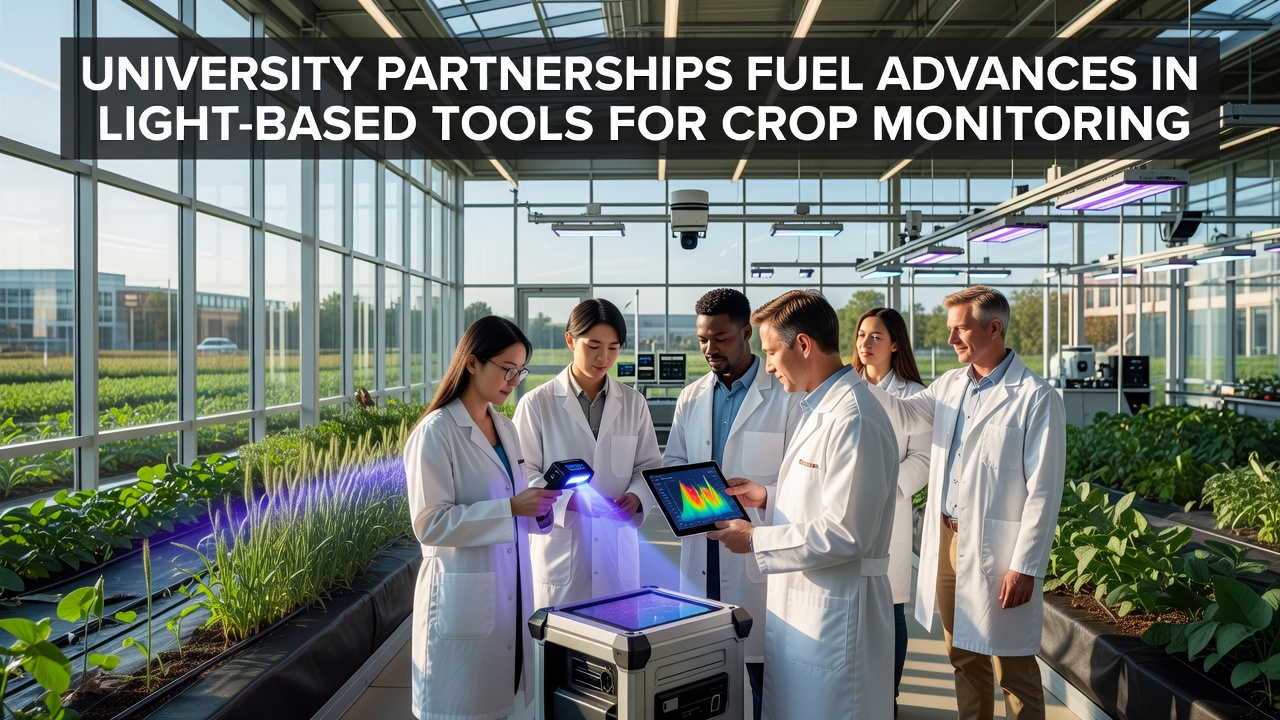
Collaborations between universities and agricultural research centers continue to expand the capabilities of optical technologies used in crop monitoring, with new systems relying on multispectral imaging, fluorescence detection, and near-infrared spectroscopy to evaluate plant conditions across large areas. These partnerships bring together expertise in photonics, agronomy, and data processing, allowing teams to refine sensors that capture subtle changes in light reflectance and absorption patterns tied to plant health indicators such as chlorophyll content and water stress levels.
Expanding Optical Methods in Precision Agriculture
Light-based tools operate by directing specific wavelengths at crop canopies and recording how plants interact with those signals, then translating the returned data into maps that highlight variations in growth or nutrient status. Research groups at institutions across North America and Europe have integrated these methods with drone platforms and ground-based rovers, creating datasets that support real-time decision making for irrigation and fertilization schedules. Data from field trials conducted through university networks show consistent improvements in detection accuracy when multiple sensor types operate together rather than in isolation.
One project coordinated by teams at Wageningen University and partners in Canada demonstrated how combining visible and short-wave infrared bands reduced false positives in disease identification by 18 percent compared with single-band approaches, according to reports published by the Agriculture and Agri-Food Canada research division. The work involved repeated measurements over two growing seasons, with calibration routines developed jointly to account for changing sunlight angles and atmospheric conditions.
Partnership Models Driving Sensor Development
University agreements often include shared access to laboratory facilities and field sites, along with joint funding streams that support prototype construction and validation studies. In Australia, researchers from the University of Queensland have worked with regional cooperatives to deploy handheld spectrometers that measure leaf reflectance at key growth stages, producing results that align closely with laboratory chemical assays. These efforts feed into larger databases used for machine-learning models that predict yield outcomes under varying climate scenarios.
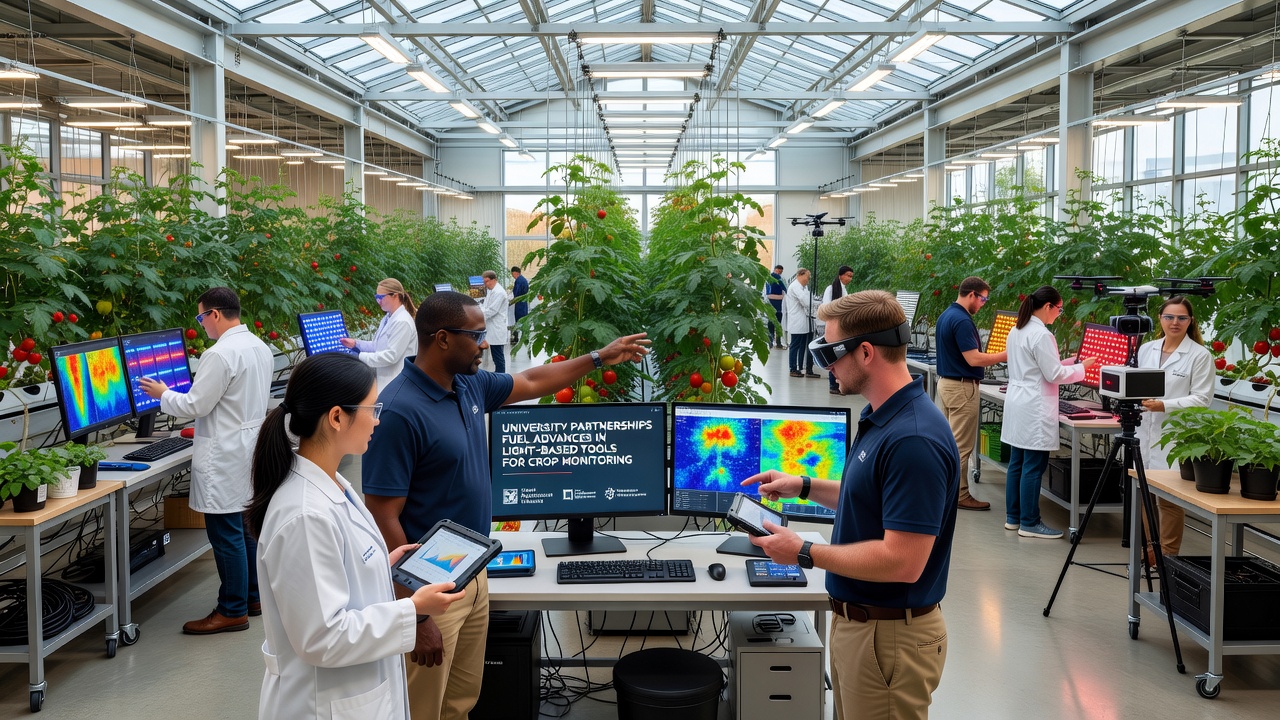
European consortia have focused on standardizing data formats so that outputs from different optical systems can be merged without extensive reprocessing. A 2025 initiative involving multiple universities produced an open calibration protocol now adopted by several commercial sensor manufacturers, shortening the time required to integrate new hardware into existing farm management platforms. Observers note that such standardization reduces duplication of effort and accelerates the transition from research prototypes to operational tools.
Recent Milestones and Upcoming Events
Advances reported in 2025 included portable fluorescence imagers capable of identifying early-stage nitrogen deficiencies in wheat and maize before visible symptoms appear. Teams at Purdue University and collaborating European labs refined excitation wavelengths and detection thresholds through iterative testing on experimental plots, achieving detection rates above 85 percent in controlled conditions. These findings were presented at regional agricultural technology meetings and have informed follow-on work scheduled for broader validation.
A symposium planned for September 2026 will bring together representatives from participating universities to review progress on integrated sensing networks that combine optical data with soil moisture readings and weather station inputs. Organizers expect presentations on scaling methods that maintain measurement consistency across different crop types and geographic zones, along with discussions of regulatory pathways for wider commercial deployment.
Data Integration and Practical Applications
University-led projects increasingly emphasize the fusion of optical outputs with other data streams, using algorithms that weight spectral signatures according to crop-specific growth models. In one documented case, researchers at the University of California, Davis, paired drone-collected multispectral imagery with ground-truth samples collected at weekly intervals, generating prescription maps that guided variable-rate fertilizer applications and reduced overall input use by measurable margins in almond orchards.
Training programs developed through these partnerships equip agricultural extension agents and farm technicians with protocols for operating and maintaining the equipment, including routine checks for sensor drift and proper alignment of light sources. Workshops held at partner institutions cover both the physics underlying the measurements and the practical steps for interpreting processed images, ensuring that end users can apply the information directly in daily operations.
Conclusion
University partnerships continue to supply the technical foundation and validation studies needed to advance light-based crop monitoring systems, with ongoing work focused on improving sensor robustness, data compatibility, and field scalability. Events scheduled through 2026 will provide additional opportunities to assess results and refine approaches that support more precise management of agricultural resources.