Amir Peters · 6 October 2026
Tracing Light's Journey from Lab Upgrades to Agricultural Fields and Medical Breakthroughs
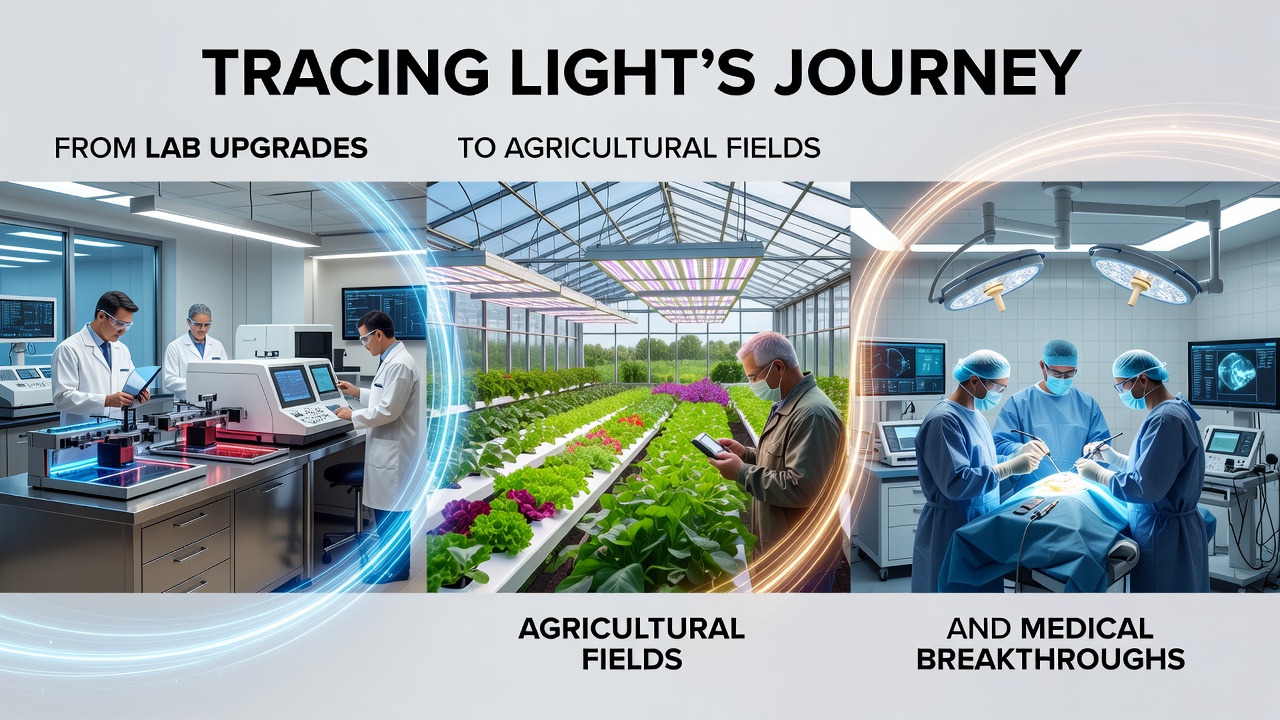
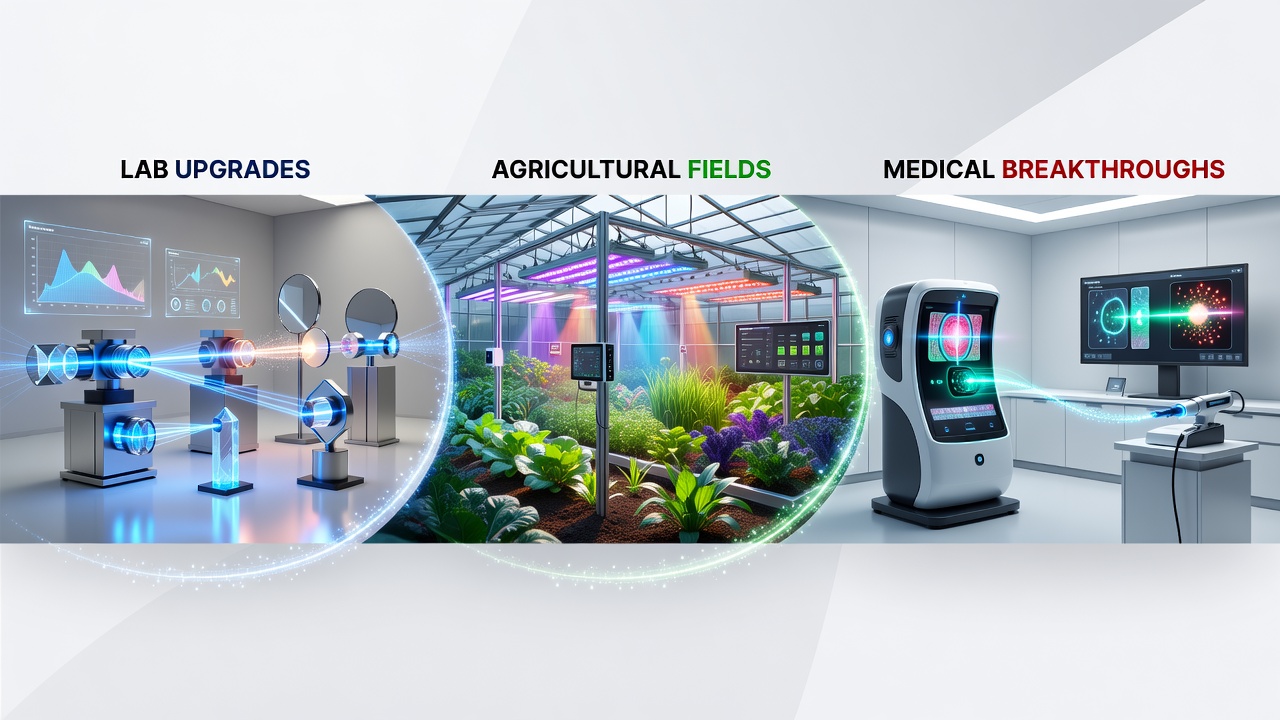
Researchers have tracked the evolution of light-based technologies from controlled laboratory environments through incremental hardware refinements that enhance precision in photon detection and wavelength control, and these developments now support expanded applications across agricultural monitoring systems and clinical diagnostic procedures. Laboratory upgrades in recent years have centered on improved laser diodes, fiber optic components, and sensor arrays that reduce signal noise while increasing resolution in scattering and absorption measurements.
Foundational Lab Improvements Drive Field Readiness
Equipment modifications in research facilities have included calibration protocols for tunable light sources along with integration of high-speed data acquisition modules, and these changes allow teams to capture subtle variations in light interaction with biological tissues or plant structures under repeatable conditions. Data collected from such setups feeds directly into models that predict how specific wavelengths penetrate crop canopies or human skin layers, which in turn informs deployment strategies outside the lab.
From Controlled Experiments to Crop Monitoring
Agricultural researchers apply these refined optical methods to assess plant health through multispectral and hyperspectral imaging mounted on drones or ground vehicles, and the techniques measure chlorophyll fluorescence alongside water stress indicators without physical contact. Studies conducted across multiple growing seasons demonstrate that light-based sensors detect early signs of nutrient deficiency or disease pressure days before visible symptoms appear, enabling targeted interventions that optimize resource use. In October 2026 several regional agricultural networks released coordinated datasets showing consistent performance gains when upgraded lab-derived calibration routines were transferred to field hardware.
What's interesting is how these transitions rely on standardized reference materials developed in laboratories, because such materials ensure that measurements taken in variable outdoor lighting conditions remain comparable across different geographic sites. Equipment manufacturers now supply portable versions of benchtop spectrometers that retain the accuracy levels previously achievable only in stable indoor settings.
Parallel Advances Reach Medical Applications
Medical device developers have adopted similar optical refinements for non-invasive imaging modalities, including optical coherence tomography systems that now resolve tissue microstructures at micrometer scales. These instruments, originally refined through laboratory iterations of light source stability and detector sensitivity, support real-time visualization during ophthalmic procedures and dermatological assessments. Research groups report that integration of compact, fiber-delivered light probes reduces setup time in operating rooms while maintaining diagnostic reliability across patient populations.
Photodynamic therapy protocols also benefit from laboratory-derived wavelength selection methods, because precise control over light delivery activates photosensitizing agents only within targeted tumor volumes and spares surrounding healthy tissue. Clinical trials tracked through international registries show expanding use of these approaches in oncology centers located in North America, Europe, and Asia-Pacific regions.
Cross-Domain Data Sharing Accelerates Translation
Observers note that open exchange of calibration datasets and validation protocols between agricultural and biomedical research communities has shortened the timeline from prototype testing to operational deployment. Government agencies such as USDA Agricultural Research Service publish guidelines that outline transfer of laboratory optical standards to field instrumentation, while parallel efforts by CSIRO in Australia document analogous pathways for medical sensor adaptation. These resources emphasize traceability of measurement uncertainty from controlled environments to variable real-world conditions.
Equipment vendors incorporate feedback loops that route performance metrics collected during crop trials back to medical engineering teams, and the iterative process refines both hardware robustness and software algorithms. In practice this means a sensor module validated for greenhouse light environments can be reconfigured for endoscopic use with minimal redesign.
Current Scale and Geographic Spread
By late 2026 commercial systems based on these laboratory lineages operate across thousands of hectares in precision agriculture programs and serve diagnostic needs in hundreds of medical facilities worldwide. Training programs at technical institutes now include modules that cover both domain applications, underscoring the shared physical principles of light propagation and detection. Regulatory bodies in multiple jurisdictions have issued guidance documents that reference laboratory validation benchmarks when approving new optical devices for either agricultural or clinical markets.
Conclusion
The documented progression from laboratory optical upgrades to deployed systems in agriculture and medicine rests on measurable improvements in light source control, detection sensitivity, and data processing pipelines. Continued refinement of these foundational elements supports expanding use cases while maintaining consistency between experimental results and operational outcomes across sectors.